Museums are responsible for preserving more than objects. Every acquisition, exhibition, loan, conservation treatment, location change, provenance discovery, and research project can generate information that contributes to the meaning and history of a collection. Over decades, this information becomes an institutional asset in its own right. Protecting it is therefore an important part of collections stewardship.
As museums manage growing volumes of information, Collections Management Systems have an increasingly important role to play. Their value extends beyond making collections information easier to search or helping staff complete everyday documentation tasks. When supported by appropriate policies, standards, infrastructure, and preservation practices, they can help museums maintain structured, traceable, and usable collections data over the long term.
Responsible data preservation, however, requires more than simply keeping information somewhere indefinitely. Museums must consider whether future colleagues will be able to find the information, understand what it means, establish where it came from, determine whether it has changed, and continue to use it as technologies evolve.
Most institutions are behind on this. The National Archives’ 2024 UK Archive Sector Survey found that nearly two-thirds of respondents had no digital preservation system in place at all — a gap likely mirrored across many museums managing similarly complex, growing bodies of collections information.
That makes data preservation not simply an IT concern, but a collections management responsibility.
What Does Responsible Data Preservation Mean for Museums?
Digital preservation is sometimes understood primarily in terms of storage: maintaining backups, moving files to new servers, or ensuring that data is not accidentally deleted. These measures are important, but preservation is broader than storage.
The Digital Preservation Coalition (DPC) describes it’s Digital Preservation Handbook as guidance for managing digital resources over time and sustaining access to them. Its recommendations encompass organizational strategy as well as practical questions involving storage, metadata, file formats, fixity, identifiers, and technical tools.
That distinction matters most for the kind of record museums keep for decades.
Consider an object record that has been developed over several decades. The record might include:
- accession and acquisition information;
- creator, maker, or cultural information;
- provenance and ownership history;
- exhibition and publication histories;
- conservation information;
- locations and movements;
- valuation and insurance information;
- rights and reproduction information;
- related people, places, events, and organizations;
- research notes and curatorial interpretation; and
- links to photographs, documents, audiovisual materials, and other digital assets.
Keeping the database containing that record backed up is essential. But responsible preservation also requires maintaining the context and relationships that make the record intelligible.
A name means little without its relationship to an object. A former location without a date can actively mislead. And a digital image with no record of what it depicts, who created it, its rights status, or which record it belongs to becomes difficult — sometimes impossible — to interpret correctly.
The preservation challenge, then, goes beyond keeping the data — it’s about keeping the data meaningful.
This is where well-designed Collections Management Systems become part of a broader preservation strategy. Here are eight ways they can help:
1. Collections Management Systems Give Information Structure
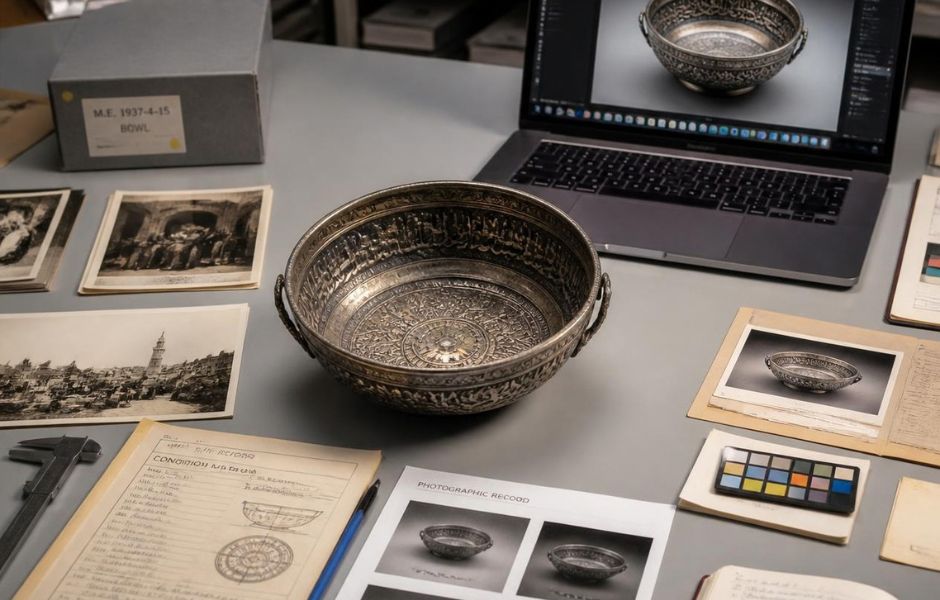
Collections Management Systems provide a structured environment in which information can be recorded according to defined fields, relationships, and workflows. This structure matters for preservation.
A museum can distinguish, for example, between an object’s current location and its previous locations; between an artist and a donor; between an acquisition date and an exhibition date; or between a preferred term and an alternative term.
Rather than preserving isolated pieces of information, the institution preserves relationships between information.
Collections Trust‘s Spectrum standards demonstrate why this is so important. Spectrum 5.1 provides guidance for 21 collections management procedures, covering activities museums undertake throughout the lifecycle of their collections. Collections Trust describes Spectrum as the UK collections management standard, while noting its international use.
A Collections Management System designed around established documentation practices can therefore help transform preservation from passive retention into structured institutional memory.
2. Standardization Makes Data More Durable
Data preservation depends heavily on consistency. Imagine that a museum has accumulated geographic information over several decades. One record says “Philadelphia”, another “Phila.”, another “Philly”, and another simply “PA”.
A human researcher may infer that some of these references describe the same place. A computer cannot necessarily make that judgement reliably.
Multiply this problem across thousands or millions of records involving artists, materials, object types, places, cultures, departments, acquisition methods, conservation terminology, and rights information, and inconsistent data becomes a significant long-term preservation problem.
Controlled vocabularies, authority records, validation rules, and standardized data-entry practices help reduce that risk.
Collections Management Systems can support these approaches by encouraging staff to reuse established terminology rather than repeatedly creating slightly different versions of the same information.
Standardization does not mean eliminating nuance. Museum information is often complex, contested, incomplete, or subject to reinterpretation. A responsible system must have room for that complexity. The objective is instead to make meaning explicit.
Structured data can distinguish a preferred term from an alternative term, a current attribution from a former attribution, or established information from uncertain information. Those distinctions help future users understand not only what the museum recorded, but also how that information should be interpreted.
3. Preserving Provenance Also Applies to Data
Museums understand the significance of provenance in relation to collection objects.
Similar thinking should be applied to collections information.
A piece of information’s own history matters: where it came from, when it was recorded, who changed it, and whether that change reflected an error or simply evolving scholarly interpretation. These questions become increasingly important as collections databases develop over decades and pass between generations of staff.
Responsible data stewardship should therefore consider the provenance of the record itself. Audit trails, modification histories, dated activities, source references, and clearly documented relationships can all contribute to greater accountability. This is especially valuable when knowledge changes.
An attribution accepted in 1995 may be reconsidered in 2026. Research may reveal that an object’s provenance is incomplete. Terminology once considered appropriate may later require review. Historical records may themselves need to be retained because they document the institution’s changing understanding of its collection.
Preservation should not require museums to freeze knowledge in time. Instead, good information management should allow collections knowledge to evolve transparently.
4. A Central System Reduces Dependence on Individual Memory
One of the less technical risks to museum data is staff turnover. Curators, registrars, collections managers, conservators, archivists, photographers, and researchers build significant institutional knowledge throughout their careers. When information remains in someone’s inbox, personal spreadsheet, or memory, that knowledge can disappear when they leave.
A Collections Management System can help move knowledge from individual custody into institutional custody. Centralizing the data is only half the job — it also needs enough context for another person to actually understand it. Recording that an object was moved is useful. Recording where it moved from, where it moved to, when the movement occurred, why it occurred, and its relationship to a loan or exhibition is much more valuable.
The distinction matters because preservation without context can produce data that technically survives but is operationally useless.
Responsible collections management therefore requires institutions to ask whether today’s documentation will make sense to a colleague who encounters it ten, twenty, or fifty years from now.

5. Collections Management Systems Can Connect Records to Digital Assets
The distinction between collections data and digital assets is becoming increasingly important. A single museum object might be associated with high-resolution photography, conservation images, installation photographs, scanned correspondence, digitized archival records, video, audio, 3D models, condition documentation, and other files.
The scale can be enormous. The Smithsonian Institution, for example, has created 8.9 million digital records for its collection objects and specimens and estimates it will need 42 million more to fully describe its 155.5-million-object collection.
Those files create their own preservation requirements. The Library of Congress, for example, evaluates the sustainability of digital formats using factors such as adoption, transparency, and technical protection mechanisms, among others. Its digital collections guidance also addresses the long-term management of file formats and future usability.
Managing the record and preserving the file are related tasks, but they are not the same one.
A Collections Management System may provide the authoritative contextual record describing an object and its relationships. A Digital Asset Management System or digital preservation environment may manage the associated files and their technical requirements. Connecting these environments helps preserve meaning alongside content.
Within the TMS Suite, for example, TMS Collections provides the core collections management environment and can work as part of an ecosystem that also supports digital asset management, conservation documentation, and web publishing.
The broader principle is more important than any individual technology: institutions benefit when digital assets remain connected to authoritative collections information rather than becoming isolated files whose significance has to be reconstructed later.
6. Preservation Requires Data Integrity
Museums need a way to know whether a digital resource has been accidentally altered or corrupted. In digital preservation, this is addressed throughfixity.
The Digital Preservation Coalition (DPC) explains that fixity is the assurance that a digital file has remained unchanged. Checksums can act as digital fingerprints: if the underlying file changes, the checksum changes, allowing an organization to identify possible corruption or alteration.
The DPC also recommends regular integrity monitoring, maintaining multiple copies of preservation material, documenting provenance, and keeping audit information.
Few Collections Management Systems perform the functions of a digital preservation repository, and museums shouldn’t assume otherwise. They work best as one part of a wider institutional ecosystem, with responsibilities clearly divided among systems.
The CMS protects the structure, context, relationships, and operational use of collections information. Backup and disaster-recovery infrastructure protect against system loss. Digital preservation processes address the long-term integrity and accessibility of digital files.
Responsible preservation comes from understanding how those components work together.
7. Access Controls Are Part of Preservation
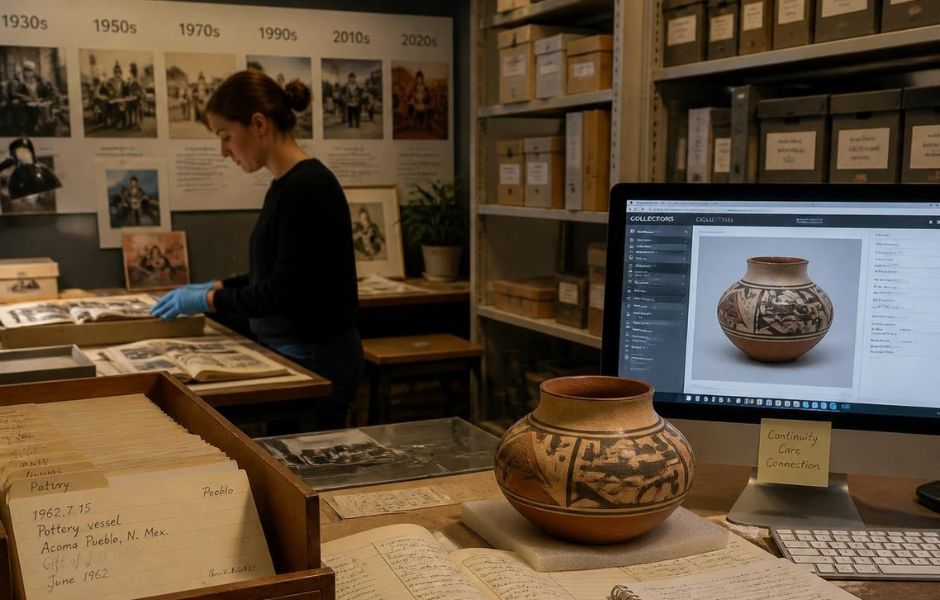
Preserving data does not mean making every piece of information available to everyone. Museum databases can contain sensitive information, including valuations, donor details, storage locations, security information, culturally sensitive knowledge, conservation records, copyright information, and personal data.
Responsible stewardship therefore requires museums to preserve information while controlling how it can be accessed and changed. Role-based permissions can help institutions establish who may view, create, edit, approve, or remove particular types of information.
That protects sensitive data and, just as importantly, protects the integrity of the collections record by reducing accidental or unauthorized changes.
Access management should consequently sit within preservation governance, not just cybersecurity. The goal isn’t merely keeping information available — it’s making sure it stays available to the right people, with changes to authoritative records happening through controlled processes.
8. Interoperability Helps Protect Against Technological Change
No museum technology lasts forever — applications change, vendors change, and file formats evolve. The National Digital Stewardship Alliance‘s Levels of Digital Preservation provides a framework organizations can use to assess and develop their digital preservation programs. Its recommendations span areas such as storage, integrity, and metadata, reinforcing the idea that sustainable preservation depends on multiple complementary practices rather than a single technology.
In 2026, the NDSA released version 2.1 of the Levels, adding environmental sustainability considerations to digital preservation decision-making.
For museums, one implication is that preservation strategies should avoid assuming that today’s technical environment will remain unchanged indefinitely.
Data portability, documented schemas, standardized metadata, APIs, integration capabilities, and established data standards can all help reduce long-term dependence on one technical configuration.
Collections Trust similarly distinguishes Spectrum itself from software: Spectrum is a collections management standard, while software providers can build systems that support its procedures. Collections Trust validates systems that meet the requirements for Spectrum Compliance.
Standards therefore offer museums something particularly valuable: continuity beyond a specific technology.

Collections Data is Part of the Collection’s Legacy
Museums often plan for the physical preservation of collections over extraordinarily long periods. The same thinking should apply to collections information: an object may survive for centuries, but its research value is diminished if its provenance, conservation history, location history, cultural context, rights information, or relationships to other material are lost.
Collections data, then, is not administrative overhead supporting the collection — in many respects; it is part of the collection’s intellectual legacy.
Collections Management Systems provide museums with an important foundation for protecting that legacy — creating structure, encouraging standardization, and making institutional knowledge accessible beyond individual staff members.
Technology alone, however, cannot guarantee preservation. The strongest approach combines appropriate Collections Management Systems with documentation standards, governance, trained staff, and clearly documented institutional policies.
For institutions using solutions such as TMS Collections and the wider TMS Suite, the opportunity is therefore larger than replacing paper files or centralizing database records. It is to establish an information environment in which collections knowledge can remain structured, connected, understandable, and useful as both museums and technologies continue to change.
Because responsible stewardship is ultimately not only about what museums preserve today. It is about ensuring that the knowledge entrusted to them can still be understood tomorrow.
Ready to strengthen your institution’s approach to collections stewardship? Connect with an expert to learn how TMS Collections and the TMS Suite can help your museum build a structured, standards-based foundation for responsible data preservation.