Museums and cultural institutions rarely fit a single operational mold. Collections vary widely in scale, material, geography, legal context, and institutional mission. An encyclopedic art museum managing international loans faces different challenges than an archive preserving born-digital materials, a historic house stewarding architectural fragments, or a contemporary institution working with living artists and time-based media. Yet all share a common reality: complexity is not an exception; it is the norm.
As collections grow more interdisciplinary and stakeholder expectations increase, rigid, one-size-fits-all systems struggle to keep pace. Increasingly, institutions are recognizing that flexibility in collections management is not a luxury, but a strategic necessity. Custom configurations, when thoughtfully designed, provide a powerful way to reflect institutional practice, support professional standards, and enable sustainable growth over time.
Complexity is Inherent to Modern Collections
Today’s collections are shaped by overlapping pressures. Regulatory and ethical requirements demand detailed documentation of provenance, rights, and restrictions. Digitization initiatives expand the scope of what must be tracked, preserved, and shared. Collaborative research, traveling exhibitions, and international partnerships require precise coordination across departments and borders. At the same time, internal teams often include curators, registrars, conservators, educators, and external partners—each with distinct workflows and information needs.
Attempting to manage this diversity within a fixed data model can lead to workarounds, duplicate records, and inconsistent terminology. Over time, these compromises erode data quality and institutional confidence. Configurable systems, by contrast, acknowledge that complexity is not something to simplify away, but something to model accurately.
Configuration as an Expression of Institutional Practice
Custom configuration is most effective when it reflects how an institution actually works, not how software assumes it should work. This includes the ability to define fields that capture collection-specific attributes, tailor workflows to mirror approval processes, and control permissions based on roles and responsibilities.
For example, an institution managing archaeological material may require detailed excavation context and stratigraphy fields, while a photography collection may prioritize editioning, copyright, and reproduction rights. Rather than forcing these requirements into generic structures, configurable systems allow institutions to surface the information that matters most to them—clearly, consistently, and without compromise.
In this way, configuration becomes a form of institutional knowledge. It encodes professional practice directly into the system, ensuring continuity even as staff, priorities, and technologies change.
Supporting Standards Without Sacrificing Flexibility
A common concern is that customization may undermine compliance with international standards such as SPECTRUM or Cataloging Cultural Objects (CCO). In practice, the opposite is often true. Configurable platforms make it possible to align closely with standards while still accommodating local practice.
By structuring workflows, controlled vocabularies, and required fields around recognized standards, institutions can support accreditation, reporting, and interoperability. This approach does not eliminate the ability to address collection-specific nuances. Thesaurus management tools, multilingual interfaces, and authority control further reinforce consistency, particularly for organizations working across languages or regions.
The result is a system that supports both rigor and relevance: standardized where it must be, flexible where it should be.
Managing Scale Through Modular Design
As collections expand, complexity often increases faster than headcount. Modular system design helps institutions scale responsibly by enabling teams to adopt functionality as needed, rather than all at once. Object records may sit at the center, but exhibitions, loans, conservation, shipping, insurance, and digital assets each introduce their own data relationships and operational demands.
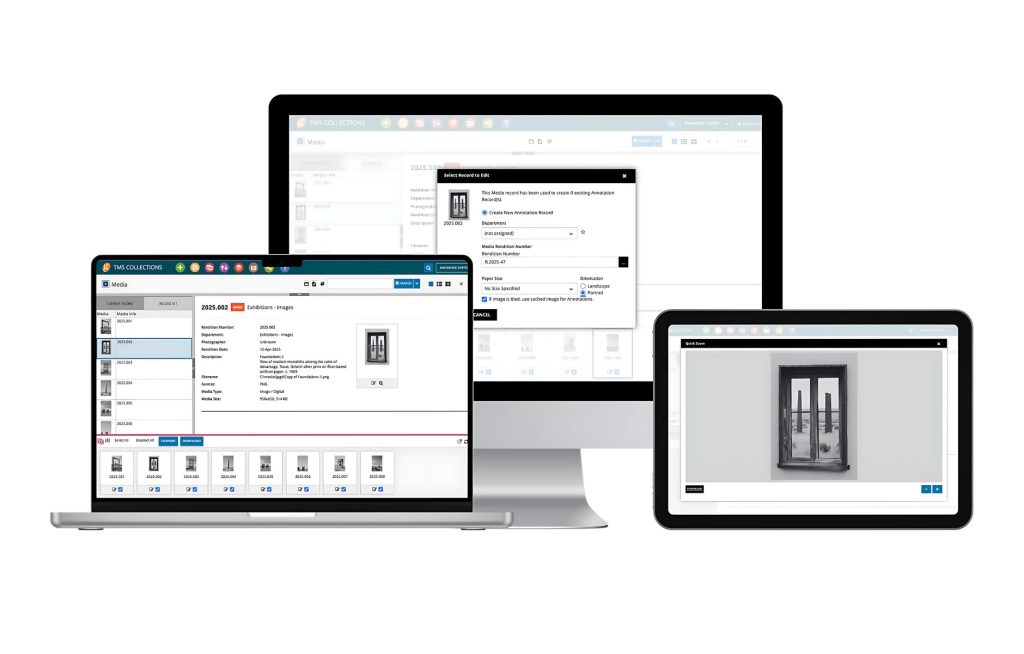
Configurable modules allow institutions to connect these activities without overburdening users with unnecessary complexity. Tailored dashboards, role-based access, and customized reports help staff focus on what is most relevant to their work.
This approach also supports long-term adaptability. New initiatives continue to emerge, such as public access platforms, advanced conservation tracking, and integrations with external systems. A configurable foundation makes it possible to evolve without destabilizing existing data.
Configuration Is a Collaborative Process
Effective configuration is not a one-time technical exercise. It is an ongoing collaboration between institutional stakeholders, system administrators, and software partners. Training and governance play a critical role, ensuring that configurations are understood, maintained, and refined over time.
Thoughtful investment in configuration, supported by documentation, training, and periodic review, enables institutions to build systems that serve both current needs and future ambitions. The collections management system becomes a living framework, capable of supporting innovation rather than constraining it.
A Platform Built for Complexity
For many institutions, the question is no longer whether they need flexibility, but where it should live. A configurable, browser-based collections management system provides a stable yet adaptable environment—one that supports diverse collections, complex workflows, and global collaboration without sacrificing usability or security.
TMS Collections has long been used by museums and cultural organizations to address these challenges at scale. Robust standards compliance, combined with extensive configuration options across fields, workflows, permissions, reporting, and integrations, allows institutions to model their collections as they truly are. This approach avoids the constraints of generic templates.
With TMS Collections at the core of a unified suite, organizations can also extend their capabilities over time, integrating digital asset management, conservation workflows, public access tools, and inventory solutions—all while maintaining a single source of truth.
Designing for the Future
Custom configuration is ultimately about stewardship. It allows institutions to respect the complexity of their collections, empower their staff, and prepare for change with confidence. In an environment where collections are increasingly dynamic, interconnected, and visible, systems must do more than store data; they must reflect institutional intent.
By embracing configurable platforms and aligning them closely with professional practice, museums and cultural institutions can transform complexity from a constraint into a strategic advantage. To discuss how TMS Collections can be configured for your collection, complete this form and an expert will be in touch.